
Dog Food Calculator: Daily Calories and Cups by Weight
Dog food calculator: daily calories from your dog's weight and life stage by the MSD Veterinary Manual formula, then cups a day from the bag's calorie line.
Affiliate disclosure: product links on this page go to Amazon or to the maker's own store. As an Amazon Associate we earn from qualifying purchases, at no extra cost to you; links to makers' own stores earn us nothing. No retailer or brand sees our picks before they are published or has any say in them. How we choose.
A healthy, neutered 50 lb adult dog needs roughly 1,164 kilocalories a day as a starting point, by the MSD Veterinary Manual's formula; on a food with 380 kcal per cup, keeping 10 percent for treats, that is about 2.8 cups a day. Enter your own dog's weight, life stage and the calorie figure from the bag below.
Every formula here is a starting point. MSD notes that two dogs of the same weight can need as much as 30 percent more or less than the calculated figure, so the scale and your dog's waistline decide what happens next.
Daily calories and cups for your dog
From the label's Calorie Content statement.
WSAVA: keep treats under 10%.
Resting energy (RER)
615 kcal/day
18.1 kg
Daily calories (MSD factor)
985 kcal/day
Adult, spayed or neutered (1.6 x RER)
Cups of this food a day
2.3 cups
886 kcal from food, split into meals
Treat allowance
98 kcal/day
10% of the daily figure
WSAVA range for an adult (inactive to active)
835 to 1,143 kcal/day
2006 NRC: 95 and 130 x kg to the 0.75
A starting point, not a prescription. RER is 70 x body weight in kg to the 0.75 power and the daily figure multiplies it by the MSD Veterinary Manual's factor for the life stage; the WSAVA range uses the 2006 NRC formulas it cites (95 and 130 x kg to the 0.75). MSD says a dog may need as much as 30% more or less than any formula. Weigh the dog every few weeks and adjust; ask your vet before cutting food for weight loss.
How the dog food calculator works
The calculator follows the method in the MSD Veterinary Manual's chapter on nutritional requirements. It first works out the resting energy requirement (RER), the calories a healthy dog uses at rest: 70 multiplied by body weight in kilograms raised to the 0.75 power. MSD notes that this exponential formula works at any body weight, while the simpler linear version (30 times weight in kg, plus 70) is limited to dogs over 2 kg and under 45 kg.
The daily figure, the maintenance energy requirement, multiplies RER by a factor for the dog's life stage. MSD's table gives these factors for dogs:
| Dog | Daily calories |
|---|---|
| Adult, intact | 1.8 x RER |
| Adult, spayed or neutered | 1.6 x RER |
| Adult, prone to obesity | 1.4 x RER |
| Puppy under 4 months | 3 x RER |
| Puppy over 4 months | 2 x RER |
For adults the calculator also shows WSAVA's range. WSAVA's calorie chart for an average healthy adult dog in ideal body condition uses the 2006 National Research Council formulas, 95 kcal times body weight in kg to the 0.75 for an inactive adult and 130 for an active one, and WSAVA labels its chart "for guidance only".
From calories to cups
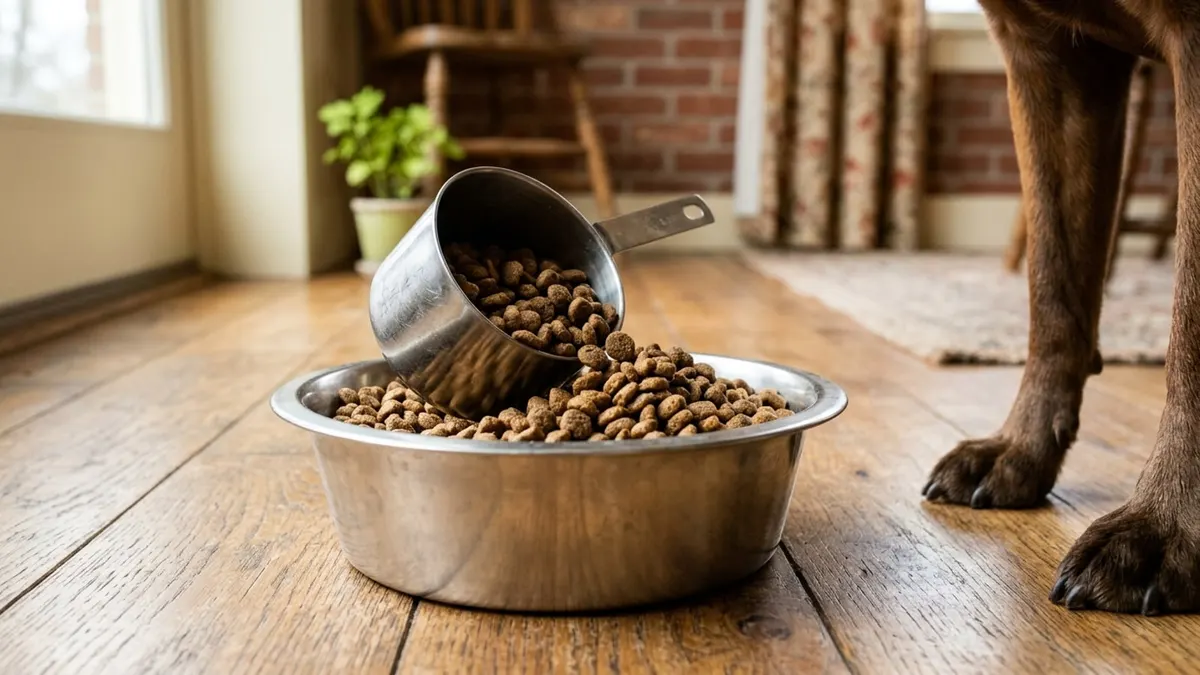
The cups figure divides the daily calories, less the treat share, by the calories per cup printed on the bag. AAFCO requires that figure under the heading "Calorie Content", in kilocalories per kilogram and per familiar unit such as a cup or a can. If your bag gives only kcal per kilogram, the maker's site or customer line will have the per cup figure; our label guide shows where to look.
Measure with a real measuring cup, not a scoop of unknown size, and weigh a cup of the food once if you want to check it. The feeding chart on the bag is a separate estimate; AAFCO itself calls feeding directions guidelines "that may need modification to meet a particular pet's needs".
The treat allowance
WSAVA's treat guide says treats should always make up less than 10 percent of a dog's daily calories, and that treats include chews and the food used to give pills. The calculator takes the treat share off the top before working out cups, so the food and the treats together stay at the daily figure. WSAVA lists a 2 oz dried pig's ear at 242 kcal and a 6.7 oz rawhide bone at 700 kcal, which is why chews belong in the count; see our training treats guide for small treats that fit the allowance.
Worked examples
These rows are the calculator's own arithmetic for four body weights; the WSAVA range covers adults only.
| Weight | RER | Neutered adult (1.6x) | Intact adult (1.8x) | Prone to gain (1.4x) | WSAVA adult range |
|---|---|---|---|---|---|
| 10 lb (4.5 kg) | 218 kcal | 348 kcal | 392 kcal | 305 kcal | 295 to 404 kcal |
| 25 lb (11.3 kg) | 433 kcal | 692 kcal | 779 kcal | 606 kcal | 587 to 803 kcal |
| 50 lb (22.7 kg) | 727 kcal | 1,164 kcal | 1,309 kcal | 1,018 kcal | 987 to 1,351 kcal |
| 80 lb (36.3 kg) | 1,035 kcal | 1,656 kcal | 1,863 kcal | 1,449 kcal | 1,405 to 1,922 kcal |
A neutered 25 lb dog on a 350 kcal per cup food, with 10 percent of calories kept for treats, works out to about 1.8 cups of food a day, split across the day's meals.
When to change the number
MSD advises that if a dog on an adult maintenance food needs 10 to 30 percent less than the label's amount to hold its weight, a less energy-dense food may suit it better than simply feeding less, because cutting a maintenance food also cuts every nutrient in it. MSD also suggests checking for medical causes, such as an underactive thyroid in dogs, when a dog needs unusually few calories to stay at a healthy weight.
- Weigh the dog regularly after any change and adjust by small steps.
- Use the ideal weight, not the current one, for an overweight dog, and ask your vet to set the target and the pace.
- Puppies change size month by month: re-run the numbers as they grow and follow the puppy food's own chart.
- Working, very active or very old dogs can sit well outside any formula.
For foods to put in the cup, see the best dry dog food and best puppy food guides.
Frequently asked questions
How many calories does a dog need a day?
By the MSD Veterinary Manual's formula a neutered 50 lb adult dog needs about 1,164 kcal a day and a neutered 25 lb dog about 692 kcal. MSD says any dog may need up to 30 percent more or less, so treat the figure as a starting point.
How do I calculate how much dog food to feed?
Work out daily calories from your dog's weight and life stage, take off the treat share, then divide by the calories per cup printed on the bag under Calorie Content. The result is cups a day, split into meals.
What is RER for a dog?
RER is the resting energy requirement: 70 times body weight in kilograms raised to the 0.75 power. The MSD Veterinary Manual multiplies it by 1.6 for a neutered adult, 1.8 for an intact adult and 2 or 3 for puppies.
How many treats can a dog have a day?
WSAVA says treats should make up less than 10 percent of a dog's daily calories. For a dog that needs 1,000 kcal a day, that is under 100 kcal of treats and chews.
Should I follow the feeding chart on the bag?
Use it as a first estimate. AAFCO describes feeding directions as guidelines that may need changing for a particular dog, and the calorie per cup figure lets you check the chart against your dog's own needs.
Why is my dog gaining weight on the recommended amount?
Formulas and feeding charts describe an average dog, and MSD notes that individual needs vary by as much as 30 percent. Weigh your dog, cut by small steps, count the treats, and ask your vet if the weight keeps rising.
Sources
- Nutritional Requirements of Small Animals, MSD Veterinary Manual
- Calorie Ranges for an Average Healthy Adult Dog in Ideal Body Condition (updated July 2020), World Small Animal Veterinary Association Global Nutrition Committee
- Feeding treats to your dog (November 2025), World Small Animal Veterinary Association Global Nutrition Committee
- Reading Labels, Association of American Feed Control Officials
- Interpreting Food Labels: North America (December 2025), World Small Animal Veterinary Association Global Nutrition Committee
Cover image: Illustration: Dog Supply Review
Related guides
Best Dog Food for Picky Eaters (2026): Complete Wet Foods and One Topper
A picky dog usually does best on a complete wet food rather than a bowl of kibble buried in extras. Purina Pro Plan's classic pate leads; Wellness Simply Shreds is the topper.
Best Dog Food for Sensitive Stomachs (2026): Four Foods and the Vet Check First
Purina Pro Plan Sensitive Skin & Stomach Salmon & Rice leads, without corn, wheat or soy. But vomiting and diarrhea have many causes, and a vet visit comes before a food change.
Best Dry Dog Food of 2026: Four Adult Kibbles Read Past the Bag
Hill's Science Diet Adult Chicken & Barley leads because Hill's prints everything a buyer needs: a feeding-trial statement, calories per cup and the full nutrient profile.