
Dog Crate Size Calculator: Measure Your Dog, Find the Crate
Dog crate size calculator using MidWest's measuring method: nose to base of tail and floor to head, plus room, matched to the five MidWest iCrate sizes.
Affiliate disclosure: product links on this page go to Amazon or to the maker's own store. As an Amazon Associate we earn from qualifying purchases, at no extra cost to you; links to makers' own stores earn us nothing. No retailer or brand sees our picks before they are published or has any say in them. How we choose.
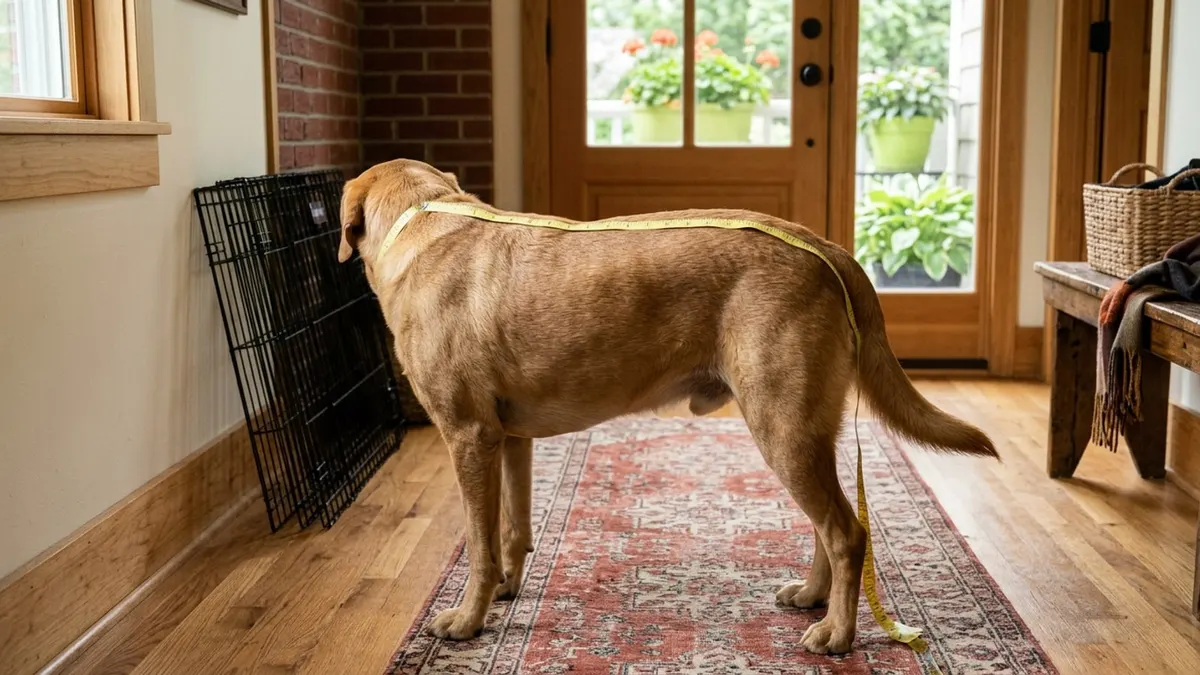
Measure your dog from the tip of the nose to the base of the tail and from the floor to the top of the head while it stands, add a few inches to each, and choose a crate at least that long and that tall: that is MidWest Homes for Pets' method, and a Labrador-sized dog of 36 by 25 inches comes out at the 42 inch iCrate. Enter your own dog's measurements below; the calculator matches them against the outside sizes printed on MidWest's five single door iCrate listings.
For a puppy, measure or estimate the adult size, as MidWest and the American Kennel Club both advise, and use the crate's divider until the puppy grows into it.
What size crate does your dog need?
Crate length needed
33 in or more
Crate height needed
27 in or more
Smallest iCrate that clears both
42 in (42 x 28 x 30 in)
MidWest iCrate 1542, listed for large breeds of 71 to 90 lb
MidWest's method: nose to base of tail, plus a few inches; floor to top of head standing, plus a few inches. The allowance is yours to set (3 inches is our default; MidWest gives no number). Crate sizes are the outside dimensions printed on each iCrate listing, so the inside is a little smaller. For a puppy, measure for the expected adult size and use the divider panel.
How the dog crate size calculator works
MidWest's sizing guide gives two measurements. Length runs from the tip of the dog's nose to the base of its tail, plus a few inches for comfortable movement; height runs from the top of the head to the ground with the dog standing upright, plus a few inches for clearance.
MidWest does not put a number on "a few inches". The calculator starts at 3 inches, our default, and lets you change it; a dog that sleeps stretched out may want more length, and the AKC's test is simply that the dog can stand up, turn around and lie down comfortably.
The calculator then picks the smallest iCrate whose length and height both meet the totals. It reads the outside dimensions from each listing's size line, so the space inside is a little smaller than the figure shown.
| Crate | Outside size (L x W x H) | Listed for |
|---|---|---|
| MidWest iCrate 24 in | 24.8 x 17.9 x 19.5 in | 12 to 20 lb |
| MidWest iCrate 30 in | 30.7 x 19.3 x 21.5 in | 21 to 40 lb |
| MidWest iCrate 36 in | 36 x 23 x 25 in | 41 to 70 lb |
| MidWest iCrate 42 in | 42 x 28 x 30 in | 71 to 90 lb |
| MidWest iCrate 48 in | 48 x 30 x 33 in | 90 to 110 lb |
Worked examples
These rows are the calculator's own arithmetic with the default 3 inch allowance.
| Dog | Length (nose to tail base) | Standing height | Needs at least | Smallest iCrate that clears both |
|---|---|---|---|---|
| A small terrier | 16 in | 12 in | 19 x 15 in | MidWest iCrate 24 in |
| A beagle-sized dog | 26 in | 18 in | 29 x 21 in | MidWest iCrate 30 in |
| A corgi-sized dog | 24 in | 15 in | 27 x 18 in | MidWest iCrate 30 in |
| A Labrador-sized dog | 36 in | 25 in | 39 x 28 in | MidWest iCrate 42 in |
| A German shepherd-sized dog | 40 in | 28 in | 43 x 31 in | MidWest iCrate 48 in |
A dog longer than about 45 inches or taller than about 30 inches standing outgrows the 48 inch iCrate; MidWest's Solutions 54 inch crate, 54 by 37 by 45 inches, is listed for giant breeds of 100 lb and up (see best dog crates).
Measuring tips
- Measure the dog standing on a flat floor, with its head in its natural position, not stretched up.
- MidWest suggests keeping treats on hand to keep a wiggly dog still.
- Measure length along the back to the base of the tail, not to the tip.
- For a puppy of a known breed, use the adult size for that breed, and MidWest says to bear in mind the size difference between males and females and the size of the parents if known.
Too big is a problem too
The AKC says a crate that is too large lets a puppy eliminate in one end and sleep in the other, which works against house training. A divider panel solves that while the puppy grows; MidWest says its divider should fit snugly across the width of the crate, not the length.
Once the crate is chosen, a crate pad sized to it finishes the setup; our dog bed guide includes K9 Ballistics' 41 by 27 inch pad for 42 inch crates, and Humane World for Animals' crate training steps are summarized in the crate guide.
Frequently asked questions
How do I measure my dog for a crate?
MidWest says to measure from the tip of the nose to the base of the tail and from the top of the head to the floor while the dog stands, then add a few inches to each. The crate should be at least that long and that tall.
How much room should a dog have in a crate?
Enough to stand up, turn around and lie down comfortably, by the AKC's rule. MidWest says to add a few inches to the dog's length and height; the calculator starts at 3 inches.
What size crate for a 50 lb dog?
MidWest's 36 inch iCrate is listed for dogs of 41 to 70 lb, but measure rather than going by weight: a long, low dog may need more length than its weight suggests.
Should a puppy's crate be sized for its adult size?
Yes. MidWest and the AKC both advise buying for the expected adult size and using a divider panel to keep the space small at first.
Are crate dimensions inside or outside?
The iCrate sizes the calculator uses are the outside dimensions printed on the listings, so the inside is slightly smaller.
Can a crate be too big for a dog?
Yes. The AKC says a puppy in an oversized crate can eliminate at one end and sleep at the other, which works against house training; a divider panel fixes that while a puppy grows.
Sources
- What Size Crate Should I Get?, MidWest Homes for Pets
- iCrate Single Door & Double Door Folding Metal Dog Crates, MidWest Homes for Pets
- How to Crate Train Your Dog, American Kennel Club
- How to Crate Train Your Dog or Puppy, Humane World for Animals
Cover image: Illustration: Dog Supply Review
Related guides
Best Chew-Proof Dog Beds of 2026: Judged by the Warranty
No bed is truly chew-proof, so the warranty is the real test. K9 Ballistics' aluminum-edged crate bed leads, with a one-time replacement if a dog damages it within a year.

Best Dog Beds of 2026: Foam, Covers and Warranties Compared
Bedsure's orthopedic sofa bed leads for most dogs, with CertiPUR-US foam and a cover that unzips from the foam. Big Barker leads for big dogs.
Best Dog Crates of 2026: Wire, Heavy Gauge, Modern and Travel
MidWest's double door iCrate leads: seven sizes, a divider for a growing puppy, and a leak-proof pan. The Ultima Pro is the heavier wire for dogs that test a crate.